
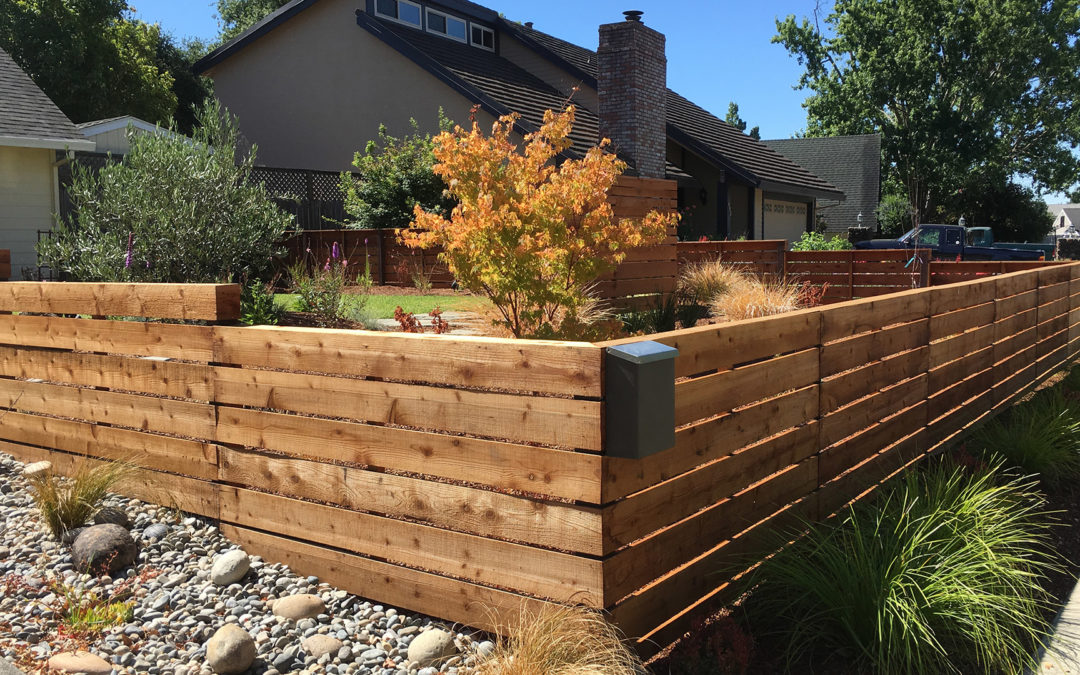
A horizontal fence has become one of the most popular fencing styles in modern landscape design. At Details Landscape Art, we have been building fences since 1991, and in recent years more homeowners have requested horizontal fencing because of its clean lines, contemporary appearance, and architectural appeal. A horizontal redwood fence
Unlike traditional vertical fencing, a horizontal fence creates strong visual lines that can make a garden appear larger and more open. The style works particularly well with contemporary homes, outdoor living spaces, and modern landscape designs.
Why Choose a Horizontal Fence?
A horizontal fence offers a unique appearance that differs dramatically from conventional fencing.
The fence can be built at a variety of heights, typically ranging from three to six feet. Fence boards may be installed with no spacing between boards for maximum privacy, or with small gaps to create a lighter and more open appearance.
Board widths may also vary. Depending on the desired look, we may use 1×4, 1×6, or 1×8 redwood boards.
These options allow each fence to be customized to complement the architecture of the home and the surrounding landscape.
Building a Horizontal Fence
One of the most important differences between a horizontal fence and a traditional vertical fence is post spacing.
Because the fence boards run horizontally, they tend to sag under their own weight if not adequately supported. For that reason, we generally space posts approximately four feet apart rather than the eight-foot spacing commonly used for vertical fencing.
Construction begins by establishing a straight string line along the desired fence alignment. The post locations are carefully laid out and excavated before the posts are installed.
Each post is aligned with string lines, leveled, and set in concrete. Proper post installation is critical because any variation in alignment becomes very noticeable with horizontal fence boards.
Once the posts are secured, the fence boards are installed from top to bottom, maintaining consistent spacing between each board.
Consistent Spacing Creates a Better Fence
Attention to detail is especially important when constructing a horizontal fence.
Small variations in spacing can become obvious over long distances. To maintain uniform spacing, we use spacers during installation to ensure each board is positioned consistently.
The result is a fence with clean horizontal lines and a professional appearance.
Whether the boards are tightly spaced for privacy or separated slightly to create a more open design, consistency is what gives the fence its finished architectural look.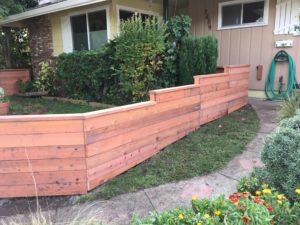 Horizontal fence with tightly spaced boards (no space)
Finishing Details Matter
This type of fence benefits from the same careful craftsmanship that contributes to any quality landscape structure.
We typically finish the fence with a redwood cap installed along the tops of the posts. The cap provides a finished appearance while helping protect the fence from weather exposure.
Many homeowners also choose to stain the redwood to enhance its appearance and extend its longevity.
A Modern Approach to Fencing
The horizontal fence has become increasingly popular because it combines function and style.
It provides privacy, security, and property definition while contributing a strong architectural element to the landscape. Whether used as a backyard screen, property boundary, or outdoor room divider, it can become an attractive focal point within the garden.
At Details Landscape Art, we frequently incorporate horizontal fencing into landscape construction projects where homeowners want a modern and distinctive appearance.