
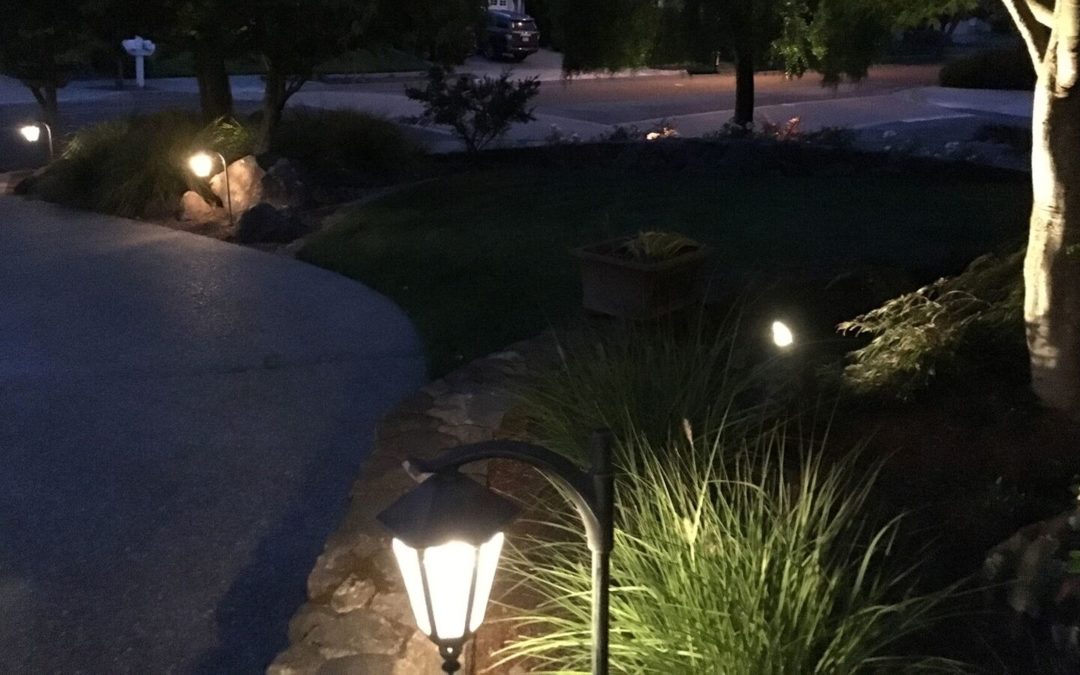
A successful low voltage outdoor lighting system requires more than simply placing fixtures around the landscape. Proper transformer sizing, cable layout, voltage management, and secure wiring connections all contribute to a lighting system that performs reliably for years.
At Details Landscape Art, we have been designing and installing low voltage outdoor lighting systems throughout Sonoma County since 1991. Careful planning during installation helps produce consistent light levels while minimizing maintenance and future service issues. Low voltage outdoor lighting
Start with a Low Voltage Outdoor Lighting Plan
The first step is determining where each lighting fixture will be located.
Typical fixtures include:
- Path lights
- Spotlights
- Up lights
- Step lights
- Accent lights
Once the fixture locations have been established, the total wattage is calculated to determine the proper transformer size.
Rather than selecting a transformer that exactly matches the lighting load, we prefer leaving additional capacity for future expansion. Homeowners frequently decide they would like an additional fixture once the system is operating, and extra transformer capacity makes those additions much easier.
Proper Transformer Sizing
As an example, twelve 20-watt fixtures require approximately 240 watts of power.
Rather than using a transformer at its maximum capacity, we would typically install a 300-watt transformer, providing room for future additions while reducing strain on the system.
Planning for expansion is inexpensive during installation and avoids unnecessary transformer replacement later.
Cable Layout Matters
One of the most overlooked aspects of low voltage outdoor lighting installation is cable layout.
If twelve fixtures are connected in one continuous line, the fixtures furthest from the transformer often receive lower voltage and produce noticeably less light.
Distance is the enemy of voltage.
Instead, we divide the lighting system into multiple cable runs.
For example:
- Six fixtures on one run
- Six fixtures on a second run
If necessary, those runs can be divided even further into smaller branches.
This branching layout distributes power more evenly and helps maintain consistent brightness throughout the landscape.
Choosing the Correct Wire Size
Most residential systems utilize 12-2 low voltage cable.
However, when fixtures are located farther from the transformer, voltage loss becomes more significant.
In those situations, we often increase the wire size to 10-2 cable, allowing electricity to travel greater distances while maintaining proper fixture performance.
Selecting the appropriate cable size during installation greatly improves long-term system reliability.
Secure Waterproof Connections
Reliable wiring connections are just as important as proper system design.
At Details Landscape Art, we separate and twist the wire strands before making each connection. When a fixture interrupts the main cable, three cable sections must be connected together:
- Incoming cable
- Outgoing cable
- Fixture wiring
The matching conductors are carefully intertwined before being secured with waterproof wire nuts.
After the wire nuts are installed, the entire connection is wrapped with heavy-duty black electrical tape. This provides additional protection and prevents wires from accidentally pulling loose over time.
Finally, each connection is secured beneath the mulch to keep it stable and protected from movement.
Professional Low Voltage Outdoor Lighting Installation
A well-designed outdoor lighting system should provide years of dependable service while beautifully illuminating pathways, patios, specimen trees, water features, and architectural details.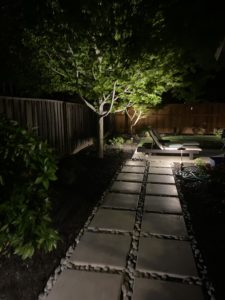 Low voltage outdoor lighting illuminates a garden pathway
Proper transformer sizing, balanced cable runs, appropriate wire selection, and secure waterproof connections all contribute to a reliable installation that requires minimal maintenance.
At Details Landscape Art, we design and install custom low voltage outdoor lighting systems that enhance both the beauty and safety of Sonoma County landscapes while delivering long-term performance.