
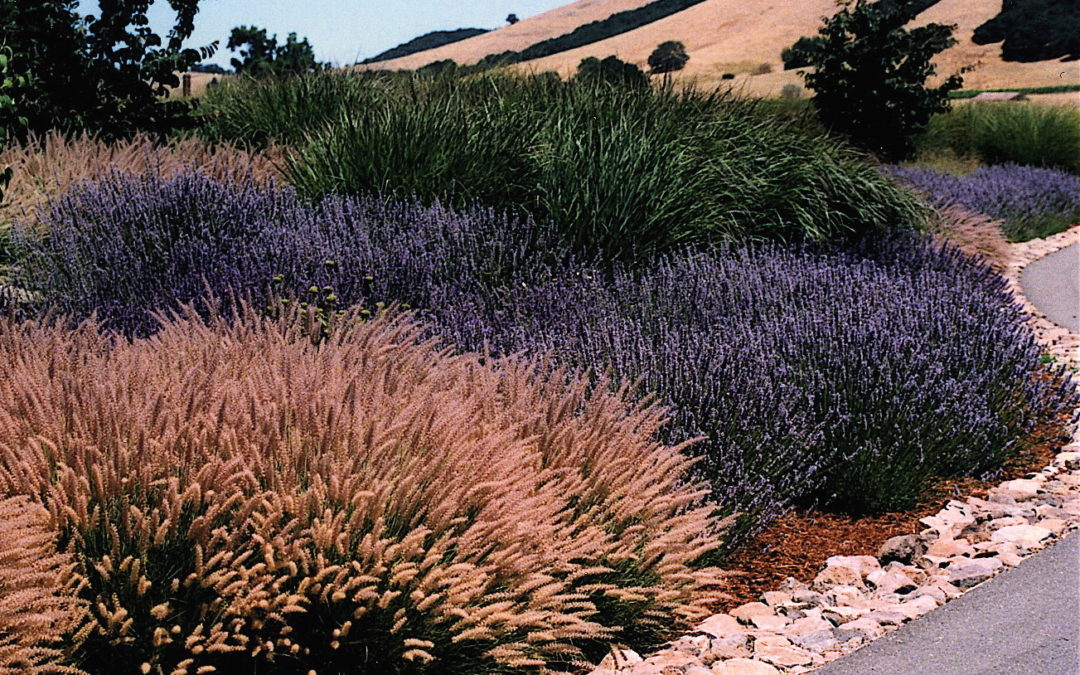
Successful plant combinations are one of the secrets to creating memorable gardens. While selecting the right plants for the right location is important, what truly separates an ordinary landscape from an exceptional one is how those plants are grouped together. At Details Landscape Art, we carefully combine plants with contrasting colors, textures, heights, and bloom seasons to create gardens that remain interesting throughout the year. Plant combinations – pennisetum orientalis and French lavender
Since 1991, we have been designing and building custom landscapes throughout Petaluma, Santa Rosa, Sonoma, and the surrounding North Bay. One of the compliments we hear most often is, “Why do your gardens look so much better than everyone else’s?” The answer is rarely one spectacular plant. It is the thoughtful combination of many plants working together.
Plant Combinations Rely on Contrast
The key to successful plant combinations is contrast.
While flower color is certainly important, professional garden design also considers:
- Texture
- Plant height
- Foliage color
- Growth habit
- Seasonal interest
- Overall balance
We often describe combinations as pairing spiky plants with rounded shrubs, soft ornamental grasses with bold foliage, or delicate branching against large-leaf evergreens. These contrasts create visual interest that keeps the eye moving through the landscape.
Sometimes Simplicity Creates the Greatest Impact
Not every garden requires dozens of different plants.
Mass planting a single variety can be extremely dramatic.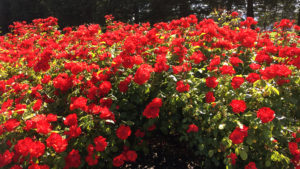 Mass planting of red roses
A large grouping of one rose variety, for example, creates a striking display because the eye is drawn to a broad sweep of consistent color rather than individual plants competing for attention.
Sometimes less truly is more.
Mix Foliage Colors and Textures
One of our favorite combinations pairs a Red Dragon Japanese maple, a white Iceberg rose, and silver-green society garlic.
The deep burgundy foliage contrasts beautifully with bright white flowers and the upright, grassy texture of the society garlic.
Another favorite combines burgundy Japanese barberry with silver-green succulents. Even without abundant flowers, the contrasting foliage creates year-round visual interest.
Flowers Are Only Part of the Story
Many homeowners focus entirely on flowers when selecting plants.
While flowers certainly add seasonal beauty, they often bloom for only a few weeks.
A hillside planted entirely for spring flowers may look spectacular in April but lose much of its impact once blooming has finished.
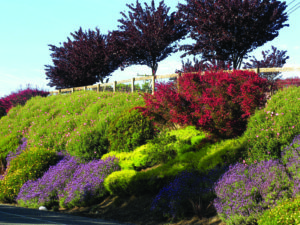 Plant combinations on a hillside
That is why we like combining flowering plants with colorful foliage, ornamental grasses, and evergreen shrubs that continue providing structure long after the blooms have faded.
Ornamental Grasses Add Movement
Ornamental grasses introduce an entirely different texture into the landscape.
One of our favorite combinations includes:
- Tamukeyama Japanese maple
- Wheeler’s Dwarf pittosporum
- Society garlic
- Gulf Stream nandina
- Bright green fescue
Each plant contributes something unique, and together they create a composition that remains attractive throughout the year.
Plant Combinations – Layer Plants by Height
Successful gardens rarely consist of plants that are all the same height.
Instead, we layer trees, shrubs, perennials, ornamental grasses, and ground covers so each plant complements the others.
One favorite combination includes:
- Akebono flowering cherry
- Coleonema ‘Gold Sunset’
- Bloodgood Japanese maple
- Japanese barberry
- Blue Wonder nepeta
- Euonymus
- Dwarf westringia
The varying heights and foliage colors create depth while allowing every plant to contribute to the overall composition.
Plant Combinations – Shade Gardens Can Be Full of Color
Shade gardens often receive less attention than sunny landscapes, yet they can be equally dramatic.
We frequently combine:
- Butterfly Japanese maple
- Atropurpurea Japanese maple
- Crimson Queen Japanese maple
- Pieris japonica ‘Temple Bells’
- Azaleas
- Camellias
The contrast between lime green, burgundy, and deep green foliage creates interest throughout the year, while spring flowers provide an added burst of seasonal color.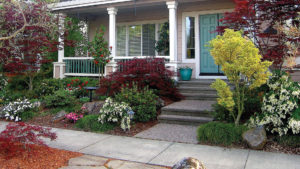 Plant combinations in a shade garden
Hardscape Completes the Composition
Plants are only one part of a successful landscape design.
Natural boulders, flagstone, decorative concrete, wood structures, dry creek beds, and water features all contribute additional color, texture, and visual balance.
The best landscapes blend hardscape and plant material into a unified composition rather than treating them as separate elements.
Professional Plant Combinations Create Lasting Beauty
At Details Landscape Art, we rarely think about individual plants in isolation. Instead, we think about how neighboring plants complement one another through color, texture, height, and seasonal interest.
Beautiful gardens are not accidental. They are carefully composed using thoughtful plant combinations that continue improving as the landscape matures.
Whether designing a Mediterranean garden, an Asian-inspired landscape, or a colorful cottage garden, the right plant combinations transform an ordinary yard into an outdoor space that remains beautiful throughout every season.