
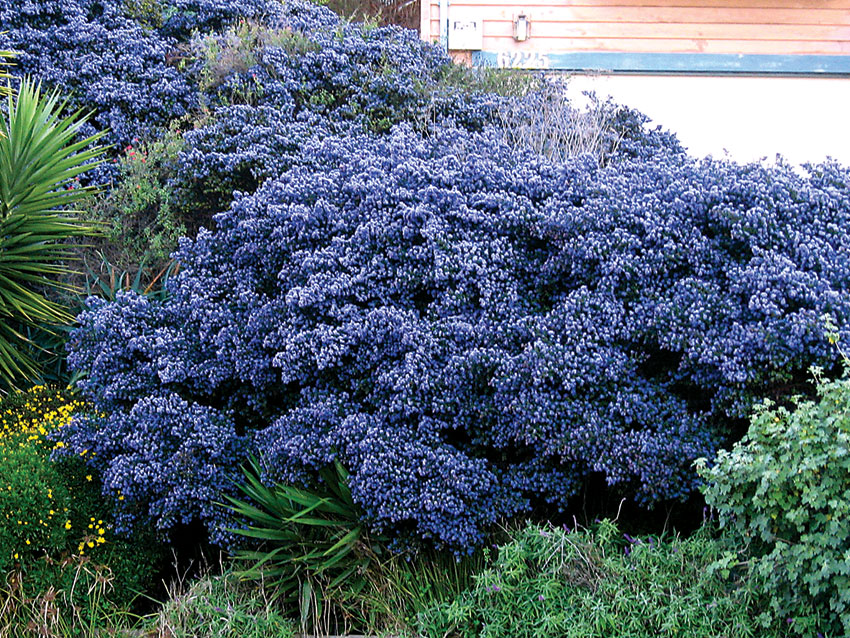
One of the staples in a garden designed and installed by Details Landscape Art is ceanothus. Deep blue ceanothus
Ceanothus is an evergreen shrub native to California, although some species do grow in the Rocky Mountains and on the East Coast. The varieties range in flower color from pale blue to deep violet blue, and even white.
Varying greatly in shape and habit, there are low ground covers that spread widely, upright varieties, and dense bushy species. They are especially useful in hillside applications.
There are larger-leafed varieties, but the smaller-leafed types are deer resistant. They generally have a relatively short lifespan, often around eight years, and then need to be replaced. Most are drought-tolerant and require only occasional summer water when established, but all require well-drained soil. Use drip irrigation only.
Common varieties we like to use are as follows:
Ceanothus ‘Yankee Point’
A sprawling, wild-looking variety growing four to five feet tall and eight to ten feet wide. They are definitely not deer resistant, but are useful in situations away from manicured areas near a residence where a more natural look is desired. Flowers are light blue.
Ceanothus ‘Julia Phelps’
Growing six to eight feet tall and wide, this small-leafed deer resistant ceanothus features deep blue flowers in early spring. We often use it as a larger evergreen background shrub.
Ceanothus ‘Ray Hartman’
We frequently use this variety as a small evergreen tree, although it can also be a very large shrub. It grows to twenty feet tall and fifteen feet wide, with larger dark green leaves and medium blue flower clusters.
Ceanothus ‘Carmel Creeper’
Ceanothus griseus horizontalis grows only two feet tall but spreads ten to fifteen feet wide, producing clusters of light blue flowers.
Other Favorite Varieties
- ‘Concha’ – dark leaves, dark blue flowers, six to eight feet tall and wide.
- ‘Gloriosus’ – low growing ground cover, one and one-half feet tall and twelve to sixteen feet wide.
- ‘Dark Star’ – slightly shorter and wider than ‘Julia Phelps’, with nearly identical foliage and flowers.
- ‘Joyce Coulter’ – medium green leaves, medium blue flowers, and a mounding habit.
- ‘Snow Flurry’ – a large shrub notable for its clusters of pure white flowers.
- ‘Snowball’ – perhaps the most drought tolerant ceanothus available.
Why We Use Ceanothus
As you can see, there are so many species available that we find endless uses for ceanothus, from small trees to larger shrubs, mounding plants, and ground covers.
They can be planted in masses or, in the case of the upright varieties, mixed with lighter foliage plants, yellow flowering shrubs such as forsythia, and even spring bulbs like daffodils.
With evergreen foliage, beautiful flowers, and adaptability to California gardens, ceanothus remains one of our favorite native plants.