

Decks have long been a popular way to create outdoor living space, especially on properties with slopes or challenging grades. At Details Landscape Art, we have been designing and installing residential landscapes throughout Sonoma County since 1991, and our approach to deck construction has evolved considerably over the years.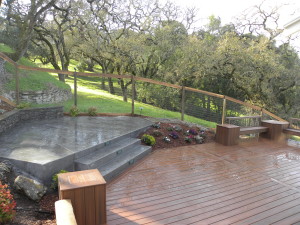 Composite deck with tables and benches
As we watched our gardens mature, we learned valuable lessons about which materials stood the test of time and which did not. Those lessons have influenced how we design outdoor living spaces today.
Decks or Patios?
When homeowners need an outdoor gathering area, they often have a choice between a deck and a patio.
On relatively flat properties, patios constructed from concrete, brick, flagstone, or other masonry materials are often the most practical solution. Patios are durable, attractive, and require very little maintenance.
On steeply sloped properties, however, a deck is frequently the better choice. Rather than importing large quantities of fill dirt or building substantial retaining walls, a deck can be supported on posts and built above the existing grade.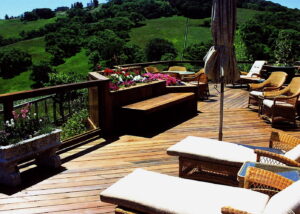 Redwood decks perform well on a hillside
This approach often reduces construction complexity while creating a functional outdoor living space that takes advantage of views and natural topography.
Why We Moved Away From Redwood Decks
In the early and mid-1990s, we built some truly beautiful redwood decks.
Many included multiple levels, custom benches, built-in planters, railings, stairs, and unique layouts that complemented the architecture of the home and the surrounding garden.
Initially, the results were spectacular.
Over time, however, we began to notice something troubling. Even premium hand-selected clear-heart redwood showed significant wear after years of exposure to sun, rain, foot traffic, and changing weather conditions.
The horizontal deck surfaces deteriorated much faster than the vertical components. While regular maintenance helped, we became increasingly uncomfortable recommending a product that did not consistently meet our long-term expectations.
Our company philosophy has always been centered around creating “Gardens for Life.” We want our projects to remain attractive and functional for decades, not just the first few years.
As a result, we often encouraged homeowners to choose patios whenever practical.
New Materials for Modern Decks
Fortunately, decking materials have improved dramatically over the past two decades.
Early generations of synthetic decking products left much to be desired. Some lacked the appearance of natural wood, while others did not perform as well as manufacturers promised.
Today’s products are a different story.
Manufacturers now offer attractive composite and synthetic decking materials in a wide variety of colors, textures, and finishes. Many closely resemble natural wood while offering superior resistance to moisture, insects, decay, and ultraviolet exposure.
Products such as Fiberon, Azek, TimberTech, Zuri, and newer generations of Trex have made decks a much more attractive option than they were twenty years ago.
Choosing the Right Deck Material
Every decking product has strengths and limitations.
One consideration is availability. Traditional redwood decking was commonly available in a variety of dimensions suitable for posts, fascia boards, railings, benches, and trim details.
Some composite products are available only in certain sizes and dimensions. As a result, we occasionally combine synthetic decking surfaces with redwood or cedar components where specific dimensions are required.
Careful planning allows us to create a cohesive appearance while taking advantage of the durability offered by newer materials.
There are also several premium hardwood decking options available, including Ipe, Cumaru, Tigerwood, and Massaranduba. These materials offer exceptional longevity and natural resistance to insects and decay while retaining the beauty of real wood.
When Decks Make the Most Sense
Decks are particularly effective when:
- The property has a significant slope
- A view should be preserved
- Existing grades make patio construction difficult
- The homeowner prefers an elevated outdoor space
- Access to different levels of the garden is required
They can also be designed with built-in seating, steps, planters, railings, and multiple levels to create unique outdoor living environments.
Outdoor Living That Lasts
Today, we are once again enthusiastic about building decks.
The creative possibilities remain as exciting as ever, but the materials have finally caught up with our expectations for durability and performance.
Whether constructed from premium hardwoods or modern composite materials, decks can provide beautiful outdoor living space while complementing the overall landscape design. When thoughtfully designed and properly built, they become an integral part of the garden and a place where homeowners can enjoy their outdoor environment for many years to come.