Rock and stone materials are important components of many landscape construction projects. At Details Landscape Art, we use a variety of crushed rock, gravel, and decorative stone products depending on the application. Understanding the differences between these materials helps homeowners make informed decisions when planning a landscape project.
Although these materials may appear similar at first glance, they each have unique characteristics and uses. Rock and stone used in a dry creek bed
Crushed Rock and Stone
The term “crushed rock” or “crushed stone” refers to natural rock that has been mechanically crushed into various sizes.
Crushed rock is generally characterized by sharp corners, irregular shapes, and relatively flat surfaces. This differs from naturally rounded gravel that has been worn smooth by moving water.
Because of its irregular shape, crushed rock tends to lock together and compact well. Larger crushed rock is often used as a base material beneath patios, walkways, and other hardscape features. Quarry fines, sometimes called stone dust, can fill the spaces between the larger pieces and create an even more stable surface.
Smaller crushed rock, typically 3/4-inch clean drain rock, packs together while still allowing water to move freely through the spaces between the stones. For this reason, we frequently use clean crushed rock in French drains and other drainage applications where rapid water movement is desired.
Crushed rock containing fines is commonly used in utility areas, pathways, and parking areas where stability is important.
Class II base rock is a recycled product consisting primarily of crushed concrete and fines. It is commonly used as a base beneath concrete patios, walkways, and driveways.
Gravel and Decorative Rock and Stone
Gravel is a natural stone that has been rounded and smoothed over time, usually by moving water.
Gravel is available in many sizes ranging from pea gravel to larger cobbles. Because the stones are smooth and rounded, they tend to move underfoot. For this reason, we generally avoid using gravel as a primary walking surface for patios or heavily traveled pathways.
Gravel does, however, have many decorative uses.
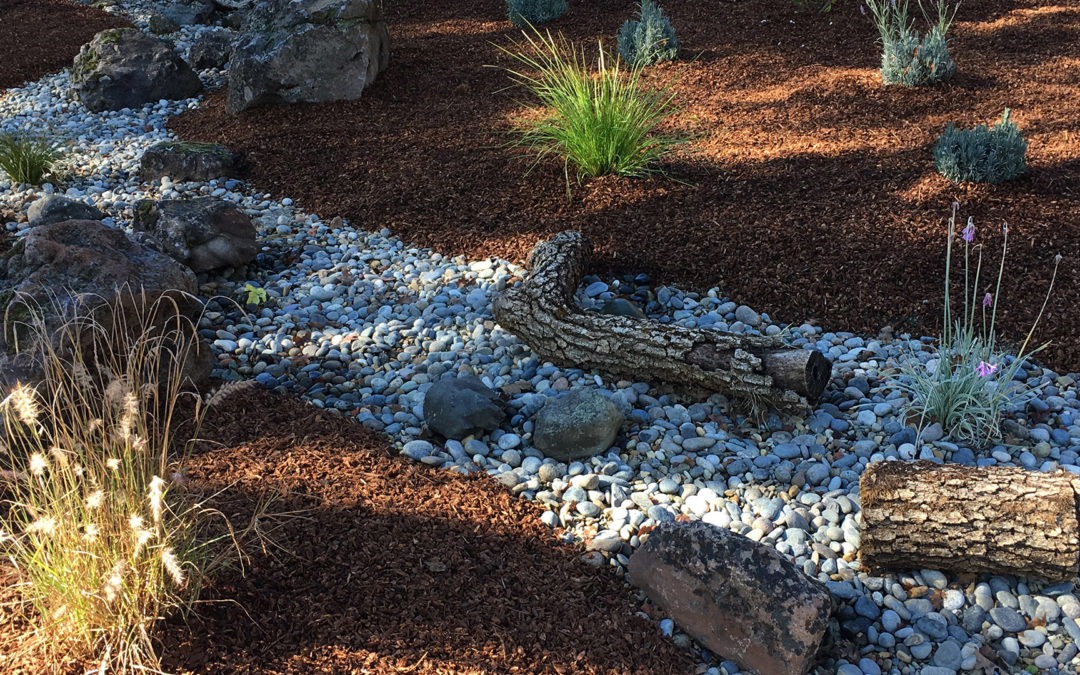
We frequently incorporate gravel into dry creek beds and naturalistic landscape features where the rounded appearance creates a realistic streambed effect.
Common decorative gravels include:
- Salt and Pepper – off-white and gray
- Sierra Tan – warm tan tones
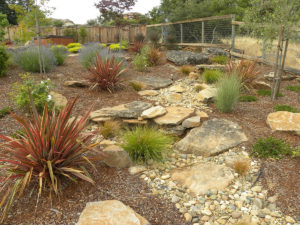 Rock and stone in Sierra tan color
 - Trinity – tan to gold
- River Rock – smooth gray stones
The wide range of colors and sizes allows decorative gravel to complement many different landscape styles.
Specialty Uses for Rock and Stone
Rock and stone materials serve many purposes beyond simple decoration.
Small decorative stones are commonly used in exposed aggregate concrete applications. The stones are embedded into freshly poured concrete and later exposed to create a durable and attractive finished surface.
Decorative stone can also be used around water features, in planting areas, and throughout drainage systems to create natural transitions between different landscape elements.
Large boulders and placement stones provide structure, focal points, and visual interest within the garden.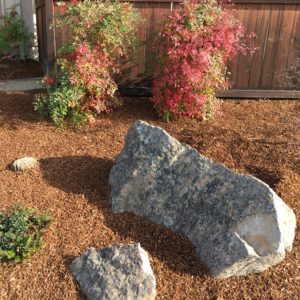 Rock and stone – large boulders
Choosing the Right Material
Each material has strengths that make it suitable for specific applications.
Crushed rock provides stability and excellent drainage characteristics. Gravel offers a softer, more natural appearance. Decorative stones contribute color, texture, and visual interest.
Choosing the proper rock and stone material depends on traffic patterns, drainage requirements, appearance, and the overall design of the landscape.
Crushed rock, gravel, and decorative stones are available in many sizes and colors throughout Sonoma County and remain important building materials in landscape construction.