
Drainage is one of the least glamorous yet most important elements of a successful landscape installation. A garden must either be graded so water naturally flows away from structures, or a drainage system must be installed to redirect the water.
There is a common saying in landscaping:
WWW – Water Will Win.
Left to its own devices, water will always find the lowest point, and over time it can create significant problems for both homes and landscapes.
Why Proper Drainage Matters
Water collecting beneath a home can contribute to dry rot, mold, and even infestations of insects and rodents. Excess moisture around plant material may lead to root rot and plant failure. Continuous contact with fences, decks, siding, and other wood structures accelerates deterioration.
Water can also damage hardscape surfaces. Standing water on patios, walkways, and steps encourages mold growth, causes discoloration, and can eventually undermine grout joints in flagstone, brick, and tile installations. Perhaps most importantly, wet hardscape surfaces become slippery and create safety hazards.
For these reasons, proper drainage should be considered early in the design and construction process.
Drainage and Landscape Grading
Many homeowners like the appearance of gentle mounds and rolling terrain in the garden. We do too.
The challenge is that mounds create valleys, and valleys collect water.
Whenever grades are altered, it is important to consider where the water will go during heavy winter storms. In many situations, a drainage system must be incorporated to move water away from low areas and toward a more desirable destination such as the street or an approved storm drainage facility.
At Details Landscape Art, we pay close attention to both grading and drainage to ensure that water is directed properly throughout the landscape.
Surface Drainage
The simplest drainage solution is often the best.
Surface drainage relies on grading the property so water naturally flows away from structures and toward a safe discharge point. When site conditions allow, this is usually the most economical and effective solution.
Good grading can eliminate many drainage problems before they occur.
Solid Drain Systems
Solid drain pipe is used to move water from one location to another.
These systems are commonly connected to roof downspouts, gutters, and catch basins. The pipe carries water underground to a designated outlet.
Proper slope is critical. Without adequate fall, water will not flow efficiently through the system.
French Drains
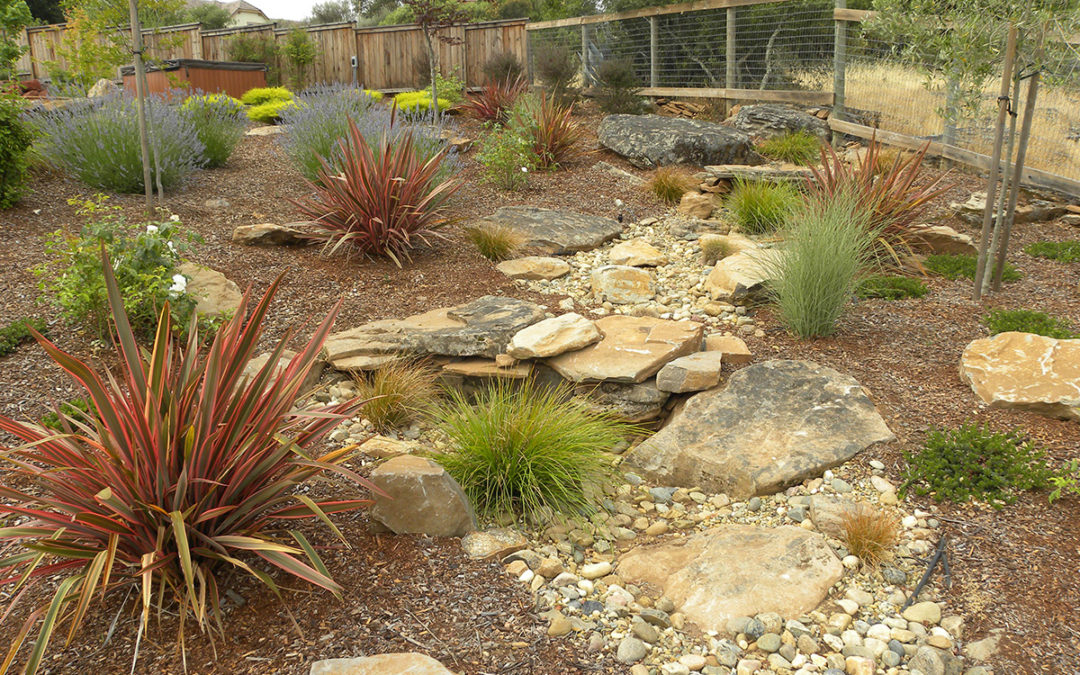
French drains are one of the most common drainage systems we install. French drain is disguised by a dry creek bed
When grading alone is not sufficient, a trench is excavated and sloped toward the desired outlet. Perforated drain pipe is installed within a bed of crushed drain rock and surrounded by additional drain rock.
The perforations allow groundwater to enter the pipe along its entire length, where it is then carried away from the problem area.
Filter fabric is used to prevent soil from entering the system and clogging the pipe over time.
French drains are particularly effective in areas where water tends to collect beneath the surface.
Channel Drains
Some situations require a more specialized solution.
Where patios, walkways, driveways, or retaining walls create unavoidable low points, a channel drain may be appropriate.
A channel drain consists of a narrow trough installed within or adjacent to a hardscape surface. The trough is covered by a removable grate and slopes toward a discharge point.
Channel drains collect surface water before it can accumulate and redirect it safely away from the area.
Water Will Always Win
One of the lessons learned over decades of landscape construction is that water problems rarely improve on their own.
Ignoring drainage issues often leads to larger and more expensive repairs in the future. Proper grading, thoughtful design, and the appropriate drainage system can prevent many common landscape and structural problems before they start.
At Details Landscape Art, we consider drainage one of the most important foundations of a successful landscape. After all, beautiful patios, healthy plants, and durable construction all depend on keeping water where it belongs.