
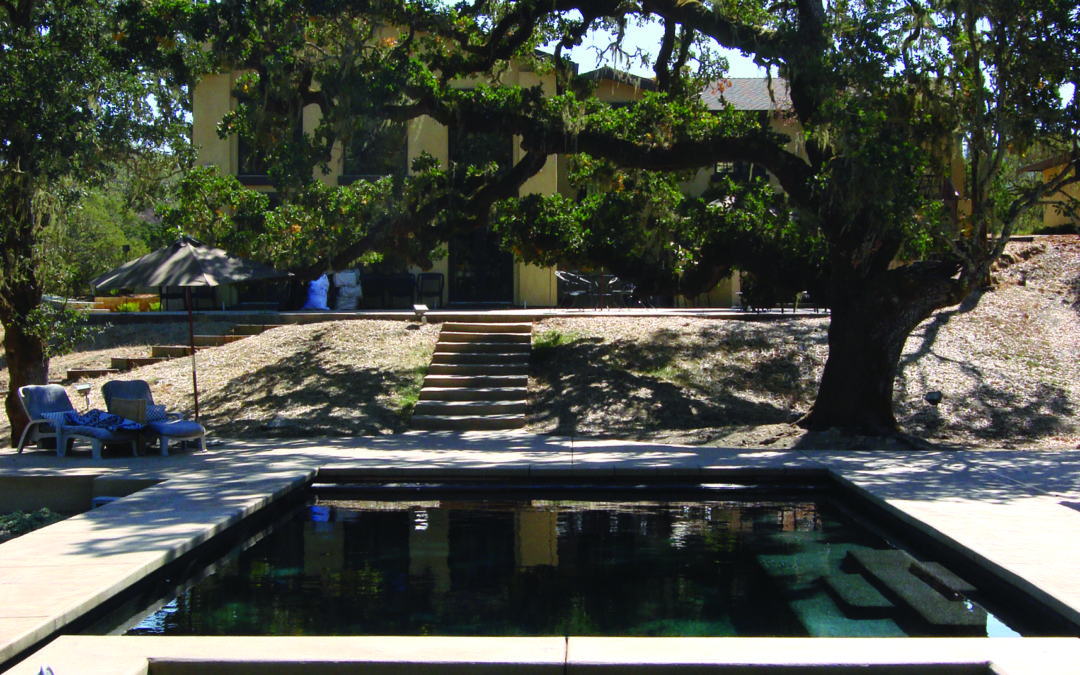
Evergreen trees play an important role in landscape design by providing year-round structure, screening, and privacy. At Details Landscape Art, we consider many factors when selecting trees for a garden, including maintenance requirements, privacy needs, available space, and the homeowner’s lifestyle. Evergreen trees frame a swimming pool
A well-designed landscape should include a balance of evergreen and deciduous plant material. Each has advantages, and understanding those differences helps create a garden that is attractive throughout the year.
Why Use Evergreen Trees?
Unlike deciduous trees, which drop their leaves all at once in autumn, most evergreen trees shed foliage gradually throughout the year. As a result, they provide continuous greenery and structure during every season.
Evergreens are especially useful for:
- Year-round privacy screening
- Background planting
- Wind protection
- Framing views
- Creating structure during winter months
The tradeoff is that most evergreen trees require occasional cleanup throughout the year as leaves or needles are shed.
Evergreen Trees for Privacy and Screening
Many homeowners want privacy from neighboring properties, second-story windows, or nearby streets.
Evergreen trees can often provide an effective solution, particularly on larger properties where there is adequate room for mature growth. In smaller gardens, screening shrubs or vines on an arbor may sometimes be more practical than a large tree.
The key is selecting the right plant for the available space and understanding its eventual mature size.
Popular Evergreen Trees
Following are several evergreen trees that have performed well in our Sonoma County landscapes.
Japanese Blueberry Tree
Elaeocarpus decipiens is perhaps our favorite smaller evergreen tree. It is relatively clean, pest resistant, and maintains attractive dark green foliage throughout the year.
California Pepper Tree
Schinus molle has a graceful, weeping habit somewhat reminiscent of a willow tree. It can be somewhat frost tender during severe winters but generally recovers well.
Mayten Tree
Maytenus ‘Green Showers’ has an elegant weeping form and makes an attractive specimen tree. It is slow growing but worth the wait.
Fern Pine
Podocarpus gracilior is one of the cleanest evergreen trees available and performs particularly well with some afternoon shade.
Olive Tree
Olea europaea is widely used in Mediterranean-style landscapes. Both fruiting and non-fruiting varieties are available, although all tend to produce some litter.
 Olive trees in a Mediterranean setting
Loquat
Eriobotrya japonica features large, attractive leaves and an interesting branching structure. It is beautiful but can be quite messy.
Camphor Tree
Cinnamomum camphora is a large shade tree with fragrant foliage. It grows slowly but can eventually reach impressive dimensions.
Popular Evergreen Trees – Conifers
Conifers offer distinctive texture and often serve as dramatic focal points in the landscape.
Redwood
Sequoia sempervirens is one of California’s most iconic native trees. It grows rapidly, develops tremendous height, and requires ample space.
Deodar Cedar
Cedrus deodara is one of the most beautiful conifers available. Its graceful, drooping habit makes it an excellent specimen tree when planted in a large enough setting.
Colorado Blue Spruce
Picea pungens ‘Glauca’ is prized for its blue-green foliage. It performs best in well-drained soils but may struggle in our relatively mild winters.
Japanese Black Pine
Pinus thunbergii remains one of our favorite pine trees due to its character, texture, and architectural appearance.
Ray Hartman Ceanothus
Although technically a large shrub, Ceanothus ‘Ray Hartman’ can be trained into a small tree form. It produces beautiful blue flowers and performs well in drought-tolerant landscapes.
Balancing Evergreen Trees and Deciduous Trees
A garden composed entirely of evergreen trees can sometimes feel static and lack seasonal interest. Conversely, a landscape dominated by deciduous trees may appear bare during winter.
The most successful gardens typically incorporate both.
Deciduous trees contribute spring flowers and fall color, while evergreen trees provide structure, screening, and visual stability throughout the year. The combination creates a landscape that remains attractive during every season.
At Details Landscape Art, we carefully balance evergreen and deciduous plant material to create gardens that are both beautiful and functional year-round.